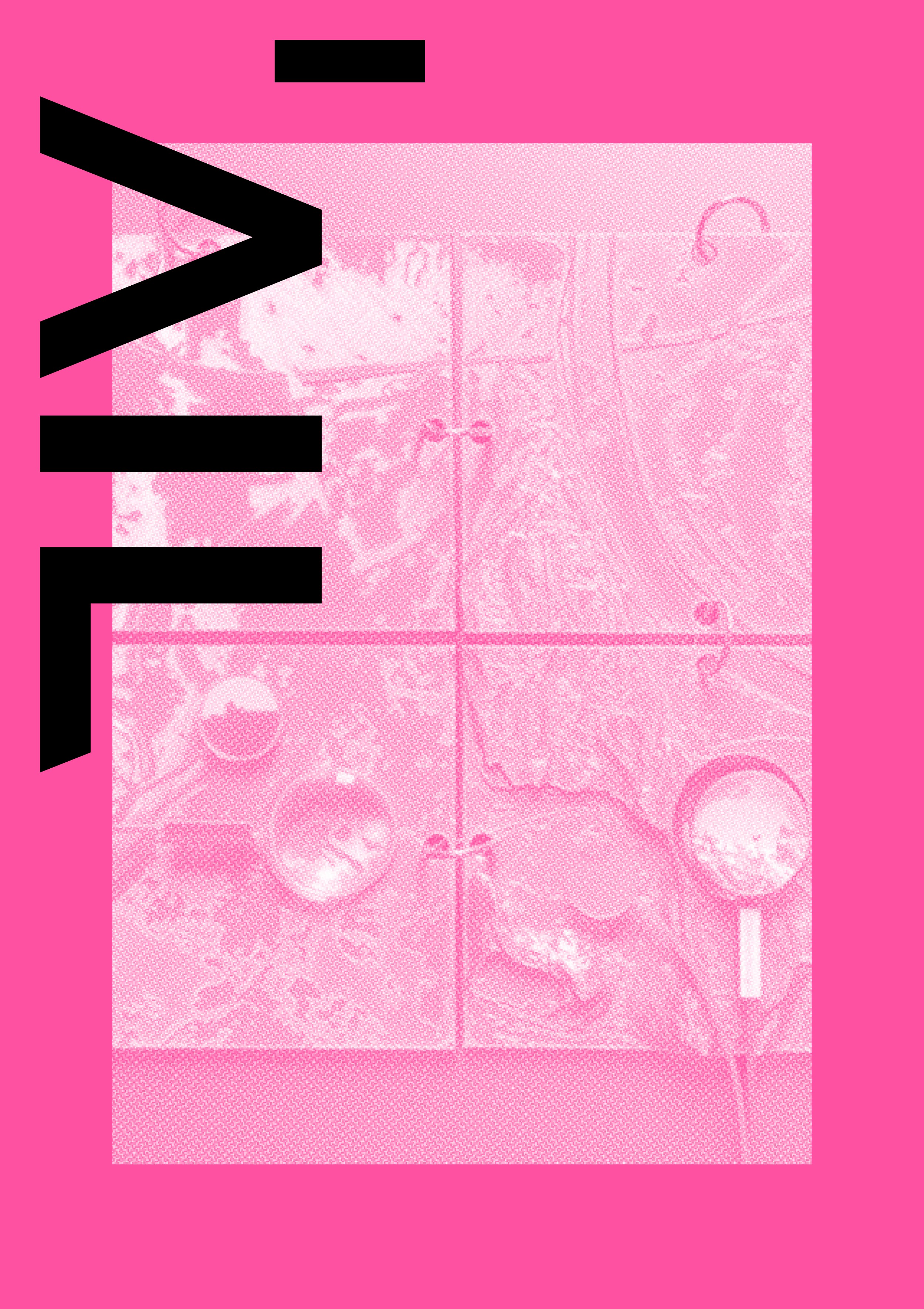
AIL Ping-Pong #3: Collapse
Showcase of artistic projects by alumni of the University of Applied Arts Vienna
©Merve Sahin, Close-up the 3D-printed terrain panel
Presented in the small vitrine of the Otto Wagner Postsparkasse, seven graduates of the University
of Applied Arts Vienna open a window into the diverse artistic practices and languages of Angewandte alumni, offering a range
of perspectives that explore parallels, contrasts, or extensions within the given thematic framework.
Intervention at Counter 13 with Francesca Aldegani,
Rosa Andraschek, Sebastian Grande, Anne Glassner, Theresa Hattinger, Matthias Kendler, Merve Sahin, Tsai-Ju Wu
In its third edition, AIL Ping-Pong circles around the term and meaning of “collapse.”
Presented in the small
vitrine of the Otto Wagner Postsparkasse, eight graduates of the University of Applied Arts Vienna open a window into their
diverse artistic practices, offering a range of perspectives that explore parallels, contrasts, or extensions within the given
thematic framework.
How do we navigate the tension between resistance and surrender? What forms of care, adaptation,
or creativity can arise from breakdown?
Collapse can be both an ending and a beginning – a sudden breakdown or
a quiet unraveling. It might describe the fall of systems: ecological, economic, or political structures that no longer sustain
themselves. It can also speak to personal or emotional states, the moments when bodies, relationships, or identities falter
under pressure. Collapse is not only destruction; it is also transformation – the point at which something gives way so that
something else might emerge.
Francesca Aldegani graduated in 2019 from the Department
of Site-Specific Art. In her artistic practice Aldegani dives into archetypal forms and geometries, interested in opening
up dialogues between ancestral collective perception and today’s digital language. Her artistic work often focuses on the
production of textile sculptures, experimental prints and ephemeral installations. Within her work she investigates the ways
history’s layers, accumulated energy, and unseen possibilities exist within everything around us.
Rosa
Andraschek is an artist living in Vienna whose work engages with the hidden layers of Austria’s past. Through photography,
video, sound and public space interventions, she investigates how history permeates everyday environments. Rooted in political
science and contemporary history, her practice makes visible the quiet traces and unresolved echoes of historical narratives
in public space. At the University of Applied Arts Vienna, she studied in the Department of Site-Specific Art and graduated
in 2025.
Anne Glassneris a visual artist and performer based in Vienna. Her performances, videos,
installations and drawings deal with intensive observations of recurring, everyday acts. In her works she blurs the boundaries
between art and life as well as fiction and reality, and she raises questions concerning self perception and external perception
as well as the intersections of the private and the public. The theme of sleep has been a central point of her artistic work
for some time now. Glassner graduated from the University of Applied Arts Vienna in 2016 from the Painting Department (Henning
Bohl).
Sebastian Grande graduated in 2019 from the Department of Drawing and Printmaking. A central
theme of his work is the transformation of everyday objects into independent protagonists. Objects of daily use shape our
environment – they fulfill practical purposes, are consumed, and discarded. He approaches his projects as environments that
reflect a society‘s collective ideas, longings, and personal histories.
Theresa Hattinger graduated
in 2017 from the Department of Graphic Design (now: Design und narrative Medien). She is a multidisciplinary designer and
artist based in Vienna and works with language, typography, textiles, drawing and the public space. Hattinger explores the
tension between strict graphic order and poetic openness, leaving room for interpretation. Her works invite viewers to reflect
on the perception of signs and symbols in everyday environments and to explore shifts in their meanings.
Matthias
Kendler graduated in 2013 from the Institute of Studies in Art and Art Education. He works at the Albertina in Collection
Management and as a visual artist in Vienna. His artistic practice focuses on minimalist kinetic works made of metal, wood,
acrylic glass, PLA, and electronics. He uses manufacturing techniques such as CNC milling, laser cutting, engraving, 3D printing,
as well as anodizing and powder coating. However, closer inspection reveals a deliberate visibility of the handmade and a
precise painterly design.
Merve Sahingraduated in 2021 from the Department of Architecture. She
is an architect and researcher addressing ecological, technological and political challenges of contemporary architecture
through speculative storytelling and works with immersive media environments and parametric architecture. Within her practice
she focuses on post-digital public spaces through world building, media ecologies and material experiments in the form of
transmedia installations. Her recent projects reclaim agency through architecture in ecologically, socially and politically
compromised environments.
Tsai-Ju Wu graduated from the Department of Site-Specific Art in 2022.
She is a visual artist, curator, and graphic designer. Her work is rooted in close observation of everyday objects and
phenomena, where playfulness meets a quiet, grounded presence. In contrast, her drawing practice is monochromatic
and abstract, moving away from recognizable forms and fixed definitions.